
01 Residency
Data stays on named machines
Prompts, documents, embeddings, indexes, conversation history and outputs live on hardware you administer. Residency is a property of the deployment, not a clause.
Sovereignty by architectureModels, documents, indexes and agents inside infrastructure you control, with external access that is explicit and governed. Our working definition, and how to deploy it.
Private AI is the use of AI models, and the data, indexes, agents and tools around them, inside infrastructure the organization controls, so that no input, output or derived artifact reaches a third party unless an operator explicitly allows it.
We know of no standard that defines the term, so this is the working definition LM-Kit builds against, stated as a definition rather than a product claim. The rest of this page states what it requires, how it sits beside local AI and the other labels it is confused with, and how to build it. The document-specific case is on Private Document Intelligence.
LM-Kit's working definition in checkable form: a deployment meets it when all four hold, and each one is a fact an auditor can verify.
01 Residency
Prompts, documents, embeddings, indexes, conversation history and outputs live on hardware you administer. Residency is a property of the deployment, not a clause.
Sovereignty by architecture02 Model control
Open-weight or fine-tuned models load from your storage, pinned to versions you set. Behaviour does not change because a provider shipped an update.
The model catalog03 Governed egress
Outbound calls are a decision: fully local by default, or selected results shared through governed tools. Administrators set the disclosure boundary.
The Trust Center04 Verifiable output
Extracted fields carry a confidence score, answers cite the document and the page, and document changes can be checked against the original.
Extraction with confidenceLocal says where the computation runs. Private says who can reach the data and everything derived from it. Two questions, four combinations, all in production.
| Where the computation runs | Private: access to data and derivatives is governed and verifiable | Not private |
|---|---|---|
| Local. On hardware you control | The whole path on your infrastructure: model, embeddings, index, logs, tools. Egress is a decision you make and record. This is the cell LM-Kit is built for. | A local chat model beside a hosted embedding API, a managed vector store or a tracing service. A frequent shape of a deployment described as "local AI". |
| Remote. On someone else's hardware | Apple's Private Cloud Compute: stateless computation, no privileged runtime access, non-targetability, and verifiable transparency through published software measurements. Private by guarantees you can verify, not by location. | A multi-tenant API with default retention logs and a contract about them. The contract can be overridden by a court order or a foreign statute; the location cannot. |
For us, privacy is a commitment. Local is how we keep it.
For any organization that cannot audit its provider's runtime, which is nearly every organization, the equation holds: private AI = local AI for the whole data path, not just the model, + models your operators pin + egress your operators govern + output you can verify. Every term after the first is something the word "local" does not promise. The sources behind each cell are in the article below.
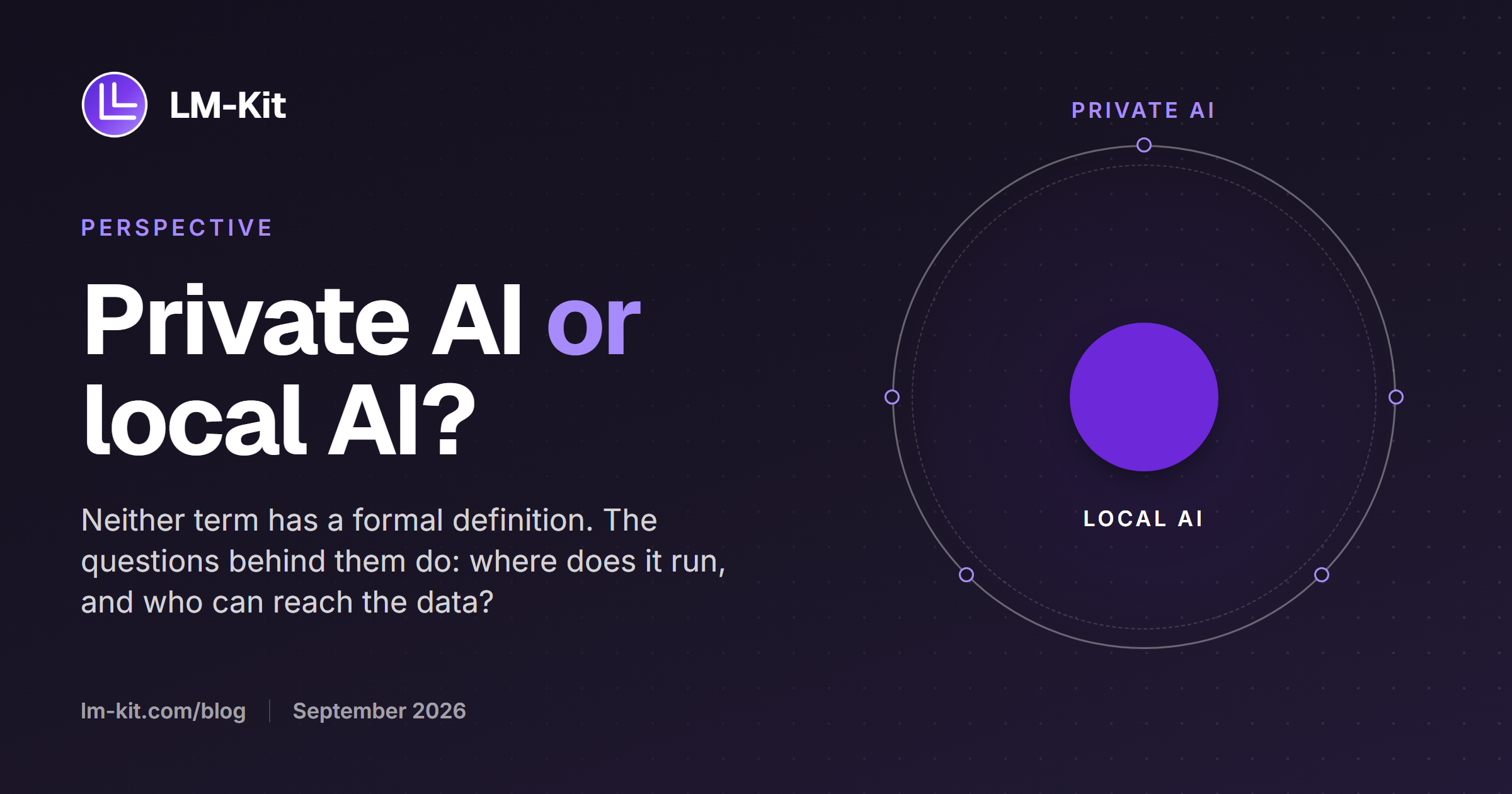
Neither term has a formal definition. The questions behind them do: where the computation runs, and who can reach the data and what derives from it. How the vendors who use each term define it, with sources.
None of these terms has a standard definition. This is what each is used to mean in practice, and the question each one leaves unanswered.
| Term | What it is used to mean | What it leaves open |
|---|---|---|
| Local AI, on-device AI | Inference runs on the machine at hand, with no network round trip. Local vs Cloud covers the trade-offs. | Where data goes next, who governs the model, whether output is checkable |
| On-premises AI | The hardware sits in a data centre you own or lease. | Whether the software phones home, whether a vendor holds a copy |
| Self-hosted AI | You operate the software yourself instead of consuming a managed service. | Governance of egress, verification of output |
| Sovereign AI | Jurisdiction and vendor accountability: whose law governs the data and the supplier. Sovereignty & EU states the facts. | The technical mechanism that enforces residency |
| Cloud AI with a privacy contract | A contractual promise about how the provider processes and retains your data. | Residency by architecture: the file is still opened elsewhere |
| Private AI | In wider usage, VMware's 2024 definition: an architectural approach that balances the gains from AI with the organization's privacy and compliance needs, wherever it is deployed. In LM-Kit's working definition: the four-property test above, enforced by the deployment and checkable by an auditor. | Capability: the stack still has to do the work |
A model runner is one component of many. Private AI is the whole stack run privately; a private model behind a public everything-else is not.
One engine, deployed to fit the constraint at hand: a shared server, a sealed network, a site with no reliable link, or the product you ship.
Shared
One installation serves every team behind the OpenAI, Anthropic, Ollama and MCP dialects, from a single machine to a load-balanced cluster.
LM-Kit OneSealed
Models pre-provisioned, no account, no activation, telemetry export off until enabled, documentation shipped inside the server.
Security architectureRemote
Field deployments, vehicles and intermittent links. A process that stops when the connection drops was never automated.
Edge & OfflineEmbedded
One NuGet compiles the same engine into your .NET application: in process, on the customer's hardware, no sidecar service and no mandatory cloud call.
LM-Kit.NETOne alone is often solvable another way. Three together is what the category exists for.
One engine, two deployment forms: a server you deploy for every application, or a runtime you embed in the one you ship.
Serve it
Models, agents, search, RAG and document intelligence behind the APIs your applications already speak, governed from one admin surface.
See LM-Kit OneEmbed it
The same capabilities directly in your .NET product, one NuGet, in process, with no Python sidecar and no cloud dependency.
See LM-Kit.NETBoth are free to build and evaluate. No activation, no time limit. The licensing terms are the same for both.
The answers we give on evaluation calls, in the same words.
No standard defines the term, so this is LM-Kit's working definition. Private AI is AI that runs inside infrastructure the organization controls: the models, the data they read, the indexes and embeddings derived from it, and the agents and tools acting on it. Nothing reaches a third party unless an operator explicitly allows it, and outputs carry evidence that can be checked.
No. Local AI says where inference runs: on the machine at hand. Private AI adds three more properties: every derived artifact stays resident, external access is a governed decision, and outputs are verifiable. A local model whose indexes or logs leave the perimeter is local, not private.
No. Fully local operation is one mode, and air-gapped deployment is supported. In the other mode an external assistant uses governed MCP tools: the sensitive work runs locally and only the result of an allowed tool is disclosed. External access is explicit and controlled, never implicit.
Open-weight models are smaller than the largest hosted ones, and the stack around them decides the outcome: layout-aware OCR, schema-constrained extraction with a confidence score per field, retrieval that cites its source, and abstention when the evidence is insufficient. Capability is measured on your hardware, on your documents, before you commit.
Owned compute replaces per-token and per-page billing with capacity you plan. LM-Kit is free to build and evaluate for both products, free in production below the published company thresholds, and licensed above them; the pricing page has the exact terms and Cost & Performance the comparison.
Download LM-Kit One and run the installer on one machine, or add the LM-Kit.NET NuGet to a .NET project. The quickstart takes either path from install to a first result.
Private AI